Vietnam Floating Markets: A Living River Heritage in Asia
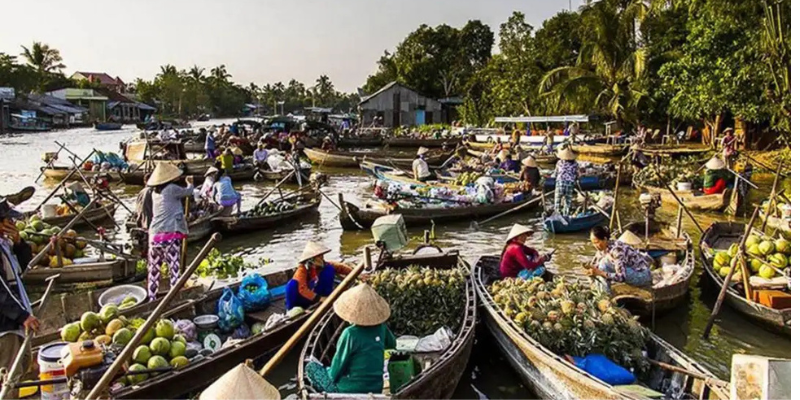
Across Asia, floating markets have long served as vibrant centers of trade and social life. From Thailand’s canal-side commerce to Indonesia’s river markets, these waterways reflect histories of adaptation, survival, and community. Yet Vietnam’s floating markets, especially those in the Mekong Delta, seem not to be receiving the same appreciation. Markets like Cai Rang Floating Market in Can Tho remain living ecosystems where daily life unfolds entirely on water.
Rooted in Vietnam’s river culture, these markets connect farmers, boat vendors, and families in a floating exchange network. Fresh produce, local cuisine, and household goods move directly from boat to boat at sunrise, sustaining both economy and tradition.
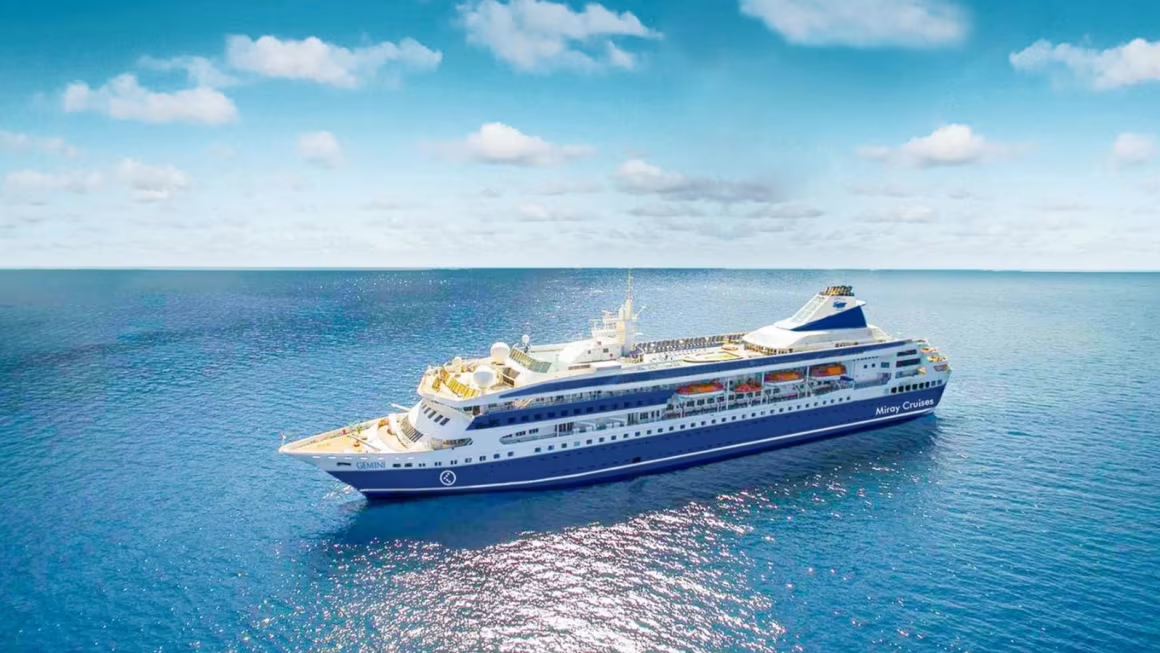
When reflecting on different ways to experience travel, I see an interesting parallel between floating market tourism in Vietnam and cruise tourism. While cruise travel offers curated luxury and structured exploration, Vietnam’s floating markets function as a “living museum” of mobility and heritage—where water connects people not just to destinations, but to food, labor, and community itself (Dieu Linh 2025).
Both forms of tourism are valid. But they tell very different stories about how we encounter culture: one through packaged comfort, the other through participation in everyday river life. Let me take you on a boat ride that is rich—not in currency, but in memory and meaning.
One of the most well-known floating market ...
Traveling on Water: The Heart of the Mekong
The floating markets of the Mekong Delta emerged centuries ago as a practical response to geography. Archaeological evidence suggests that river trading in southern Vietnam dates back more than 4,500 years, reflecting how the region’s dense network of rivers and canals made water transport the primary mode of mobility (ANU 2017).
By the early twentieth century, river trading had reached its peak. Markets such as Nga Bay, Nga Nam, and Cai Rang Floating Market became major trading hubs, where hundreds of boats gathered daily to barter rice, fruit, and agricultural products. These floating markets were not temporary attractions but essential economic anchors of the Mekong Delta. (Dieu Linh 2025)
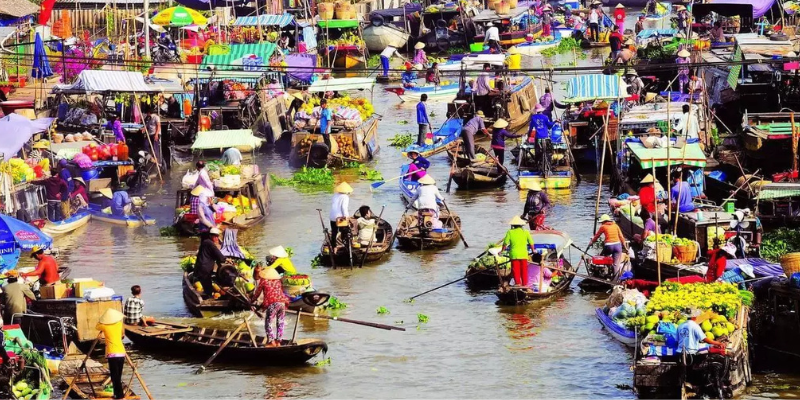
Tra On Floating Market (Cre: Vietnam Travel)
Cai Be Floating Market (Cre: Vietnam Escape Tour)
The floating markets of the Mekong Delta are defined by mobility—where people, goods, and river culture continuously interact and complement one another. Beyond serving as commercial spaces, these markets function as living communities that express their identity through everyday trade on water. By welcoming visitors into what is normally part of daily life, Vietnam’s floating markets offer a rare opportunity to witness authentic river culture. For this reason, travelers should approach these markets not as staged attractions but as meaningful spaces for cultural exchange and learning.
So what exactly is there that can give tourists an unforgettable experience?
The Culture of Vietnam Floating Market: Customs, Commerce, and Culinary Abundance
Vietnamese floating markets operate with their own unwritten rules and customs, shaped by generations. Here are some interesting customs that you might only see in the Mekong Delta:
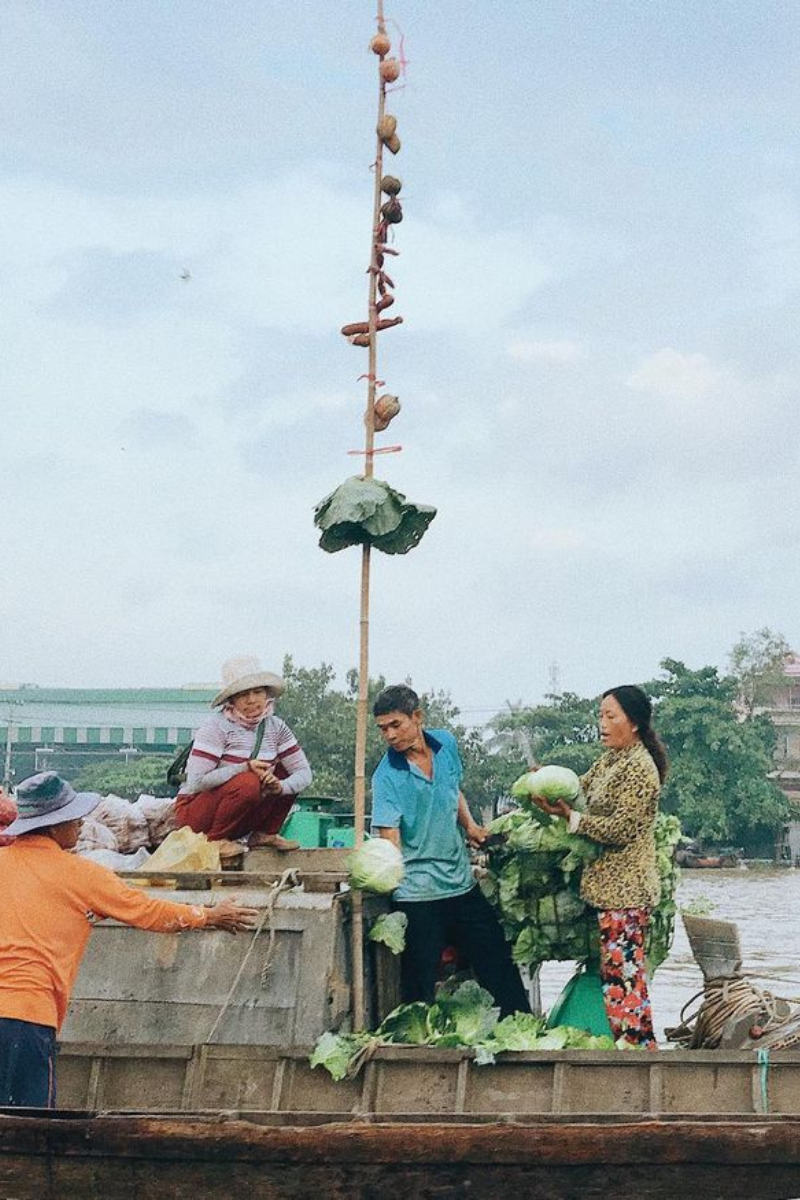
The “Cây Bẹo” (Trading Poles):
One of the most distinctive features of the Mekong Delta floating markets is the cây bẹo—a tall bamboo trading pole attached to each vendor’s boat. Instead of shouting over the roar of engines, sellers hang samples of their goods directly on the pole. Durians, bananas, pumpkins, or bundles of sweet potatoes are lifted high above the water, signaling to passing buyers what is available for sale.
This simple yet unique system allows trade to continue efficiently despite the constant engine noise and movement on the river. The cây bẹo functions as both an advertisement and a communication tool, reducing the need for verbal negotiation from a distance. In markets like Cai Rang Floating Market, these poles create a visual landscape of suspended produce—turning the river itself into a floating marketplace of signs and symbols (Brown 2024).
More than a practical solution, the cây bẹo reflects the adaptability of Vietnam’s river culture, where commerce, environment, and community are closely intertwined.
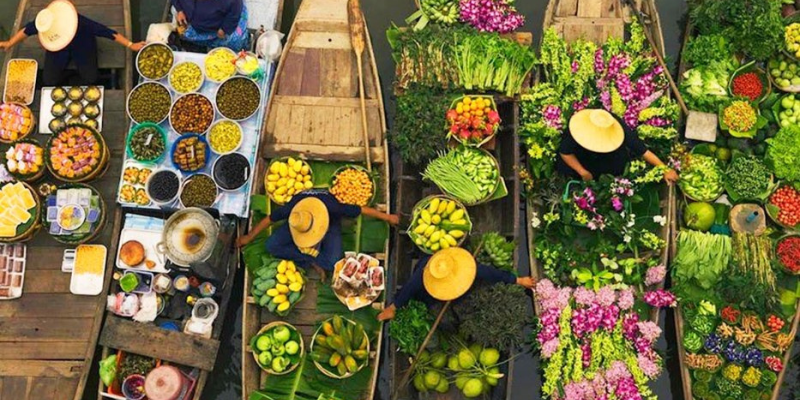
This merchant is selling some ingredients such as cabbages (Cre: Viet Fun Travel)
Fresh Ingredients and Local Delicacies at Mekong Delta Floating Markets
The Mekong River Delta is Vietnam’s agricultural heartland, producing approximately 50% of the country’s rice and nearly 75% of its fruit, along with significant aquaculture and fishery products (Brown 2024). Vietnam is also one of the world’s top rice exporters, ranking behind India and Thailand. This agricultural abundance is most visibly concentrated in the floating markets of the Mekong Delta, where boats are loaded with locally-sourced produce.
At markets such as Cai Rang Floating Market, vendors sell locally grown mangoes, durians, pineapples, and vegetables not only for household consumption but also for wholesale and resale. The river functions as a moving supply chain, connecting farmers, traders, and retailers in a continuous flow of exchange.
The experience is rather intimate. Sellers may slice open freshly harvested fruit and offer samples to visitors, inviting them to taste before purchasing. As boats drift from one vendor to another, eating becomes part of the journey itself. In this way, the floating markets transform the Mekong Delta’s agricultural richness into an experience-filled form of tourism—where the region’s most distinctive flavors are enjoyed in motion.
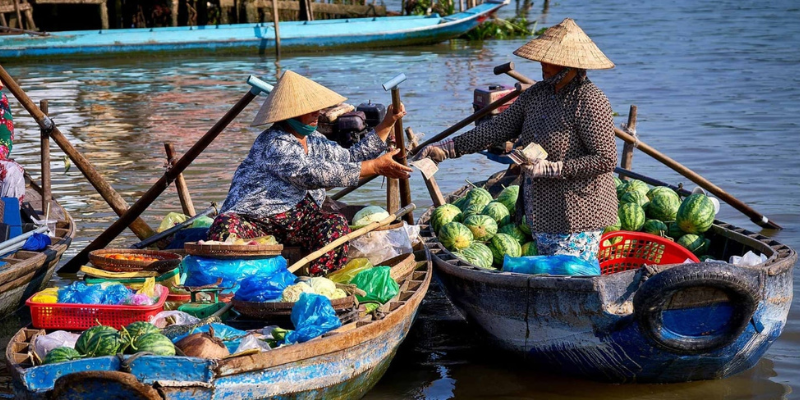
Merchants trading their products (Cre: Experience Travel Group)
Floating boats with fresh produce (Cre:Vietnamimmigration)
“Hot-to-Go”: Must-Try Food at Mekong Delta Floating Markets
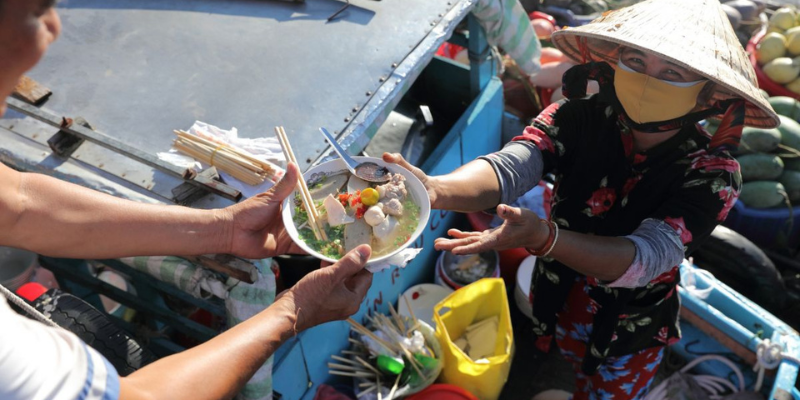
For food lovers, visiting the floating markets of the Mekong Delta is one of the best ways to experience authentic Vietnamese cuisine. Each market features local specialties that reflect regional ingredients and cooking traditions. From freshly prepared noodle soups to grilled meats served straight from the boat, the culinary diversity on the river is both accessible and immersive.
Below are some must-try dishes when exploring Vietnam’s floating markets:
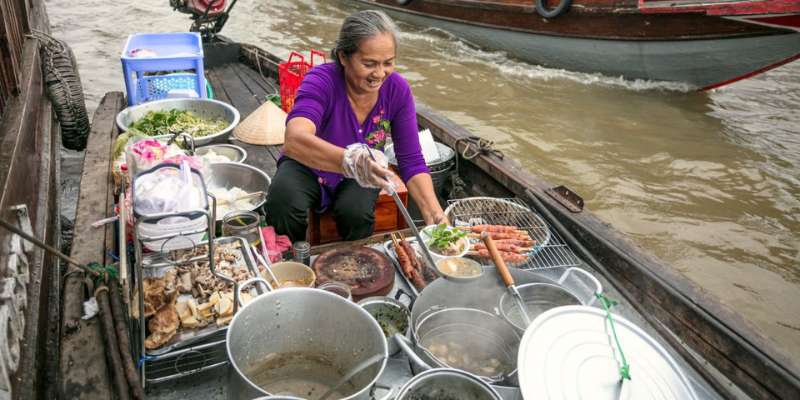
Serving food on water
(Cre: vivujourneys)
Bún Thịt Nướng (Grilled Pork with Rice Noodles)
Bún thịt nướng is a popular dish at Mekong Delta floating markets, valued for being quick to prepare, moderately portioned, and easy to eat on the move. The combination of light rice vermicelli, smoky grilled pork, and fresh herbs makes it flavorful without being heavy—ideal for travelers who want to sample multiple dishes while drifting from boat to boat.
Often prepared directly on vendor boats, this dish reflects the practical, mobile nature of floating market cuisine, where food must be both efficient and satisfying.
Bún Riêu Cua (Vietnamese Crab Noodle Soup)
Another popular dish at Mekong Delta floating markets, bún riêu cua, is often sold from the same boats that prepare other noodle specialties, such as bún thịt nướng. This allows visitors to have a variety to choose from—or even try both while exploring the river.
Bún riêu features a light tomato-based broth topped with minced freshwater crab. The crab mixture is traditionally made from small paddy field crabs—commonly the brown paddy crab—found in Vietnamese rice fields. After being carefully cleaned to remove dirt and sand, the crabs are pounded whole, shells included, into a fine paste that forms the rich, savory base of the soup.
Served in modest portions, bún riêu is comforting yet not overly heavy. Its balance of tangy broth, delicate crab flavor, and fresh herbs makes it ideal for enjoying while drifting from one food boat to another in the floating market.
From coffee and bánh mì to bite-sized snacks, floating food boats drift through the market, creating a lively, moving tapestry of Vietnamese flavors and appetite.
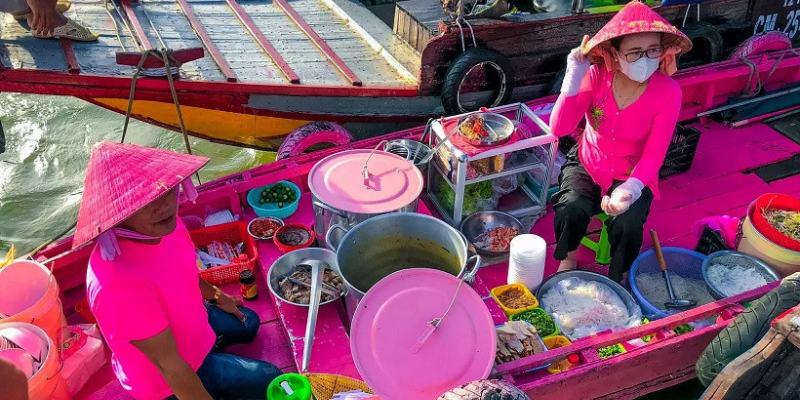
A famous Bun Rieu Cua selling boat went viral for their vibrant color then attracted even more people for their delicious noodle dish (Cre: Vietnamnet/Pham Do Minh Chung)
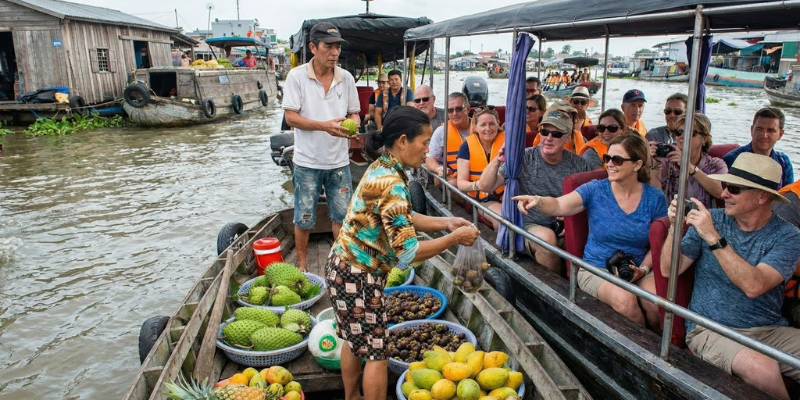
Merchants selling fresh fruits to tourists (Cre: Ytb: Vietnam Daily)
Traveling with Grace: Experiencing Vietnam’s Floating Markets with Respect
Filled with color and movement—from rippling water and hanging produce to the vibrant clothing of vendors—the floating markets of the Mekong Delta are a dream destination for photography enthusiasts. Publications such as The Telegraph have even listed Vietnam’s floating markets among the best places to visit in Southeast Asia for striking travel photography (Ngoc Dinh 2016).
Yet these markets are more than scenic backdrops. The Mekong Delta floating markets are not staged attractions designed for quick photo opportunities; they are living communities where families work, trade, and sustain their livelihoods. What visitors witness is not a performance, but everyday life unfolding on the river.
For this reason, travelers should approach floating markets with attentiveness and respect. Rather than simply passing through, take time to observe, converse with vendors, and appreciate the rhythms of river culture. When experienced thoughtfully, these markets reveal more than colorful imagery—they offer insight into a community shaped by water, cooperation, and tradition.
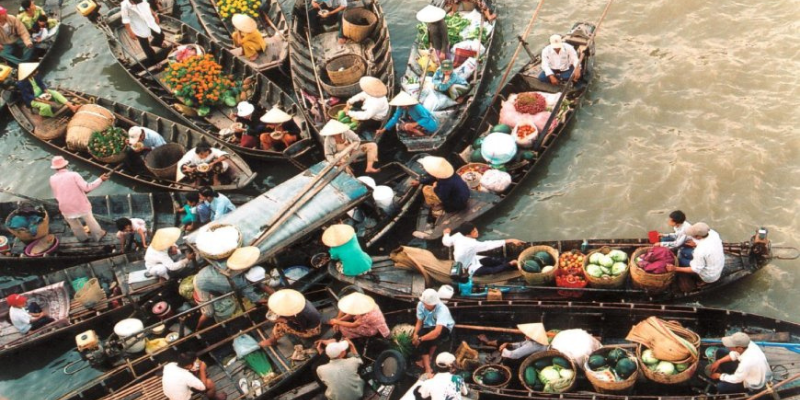
Closely-intertwined boats on the Mekong Delta (Cre: Traveloka)
Enjoying hot meal on the go
Cre: vivujourneys
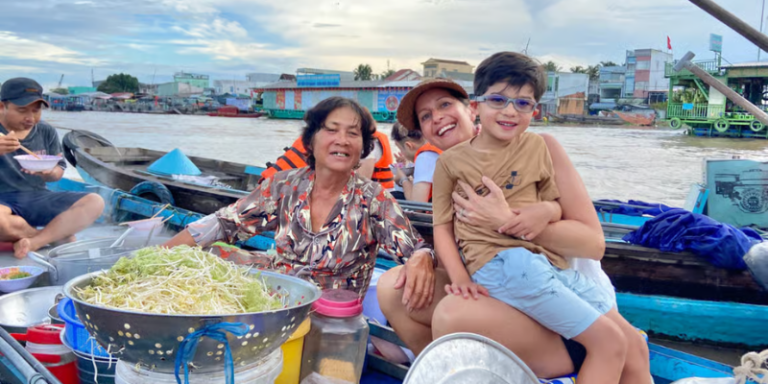
Not just a destination, but a community of love and compassion (Cre: GetYourGuide)
Conclusion: Vietnam’s Floating Markets — Where River Traditions Meet Sustainable Development
Despite their beauty and cultural significance, many floating markets in the Mekong Delta are shrinking. In some areas, market activity has reportedly declined by nearly 50% over the past decade (Brown 2024). As road infrastructure expands and wholesale distribution shifts inland, river-based trade is no longer the primary economic system it once was.
In response, local authorities have attempted to preserve these markets through tourism development—establishing designated tourist zones and expanding food stalls to attract visitors. However, increased sightseeing does not always translate into meaningful economic benefit for local vendors. Simply bringing more tourists to the river does not automatically sustain the community that depends on it.
For such, Vietnam’s floating markets need to be enjoyed with broader conversations about the Sustainable Development Goals (SDGs)—particularly those related to decent work (SDG 8), sustainable communities (SDG 11), and responsible consumption (SDG 12).
Preservation must go beyond aesthetic appreciation. It requires supporting local livelihoods, encouraging direct purchasing from vendors, and promoting forms of tourism that are community-centered rather than extractive.
For this reason, visitors are encouraged to experience the floating markets while they still thrive—but to do so with intention. Travel not only to witness tradition, but to help sustain it.
Thoughtful travel means keeping the Sustainable Development Goals (SDGs) in mind: supporting decent livelihoods by choosing local boat operators (SDG 8), practicing responsible consumption by purchasing directly from vendors (SDG 12), and remaining aware of the environmental pressures facing river communities in the Mekong Delta (SDG 13) (Thomas Vietnam 2025; Kiser 2025).
Tourism ultimately shapes whether these river-based livelihoods continue. When travel strengthens local economies without degrading the environment, it becomes a force for preservation rather than decline.
Selling Out Foods and Fresh Ingredients Doesn't Seem So Difficult With the Help of Curious Tourists...
This sentiment should extend beyond the floating markets of the Mekong Delta to any community that has opened its everyday life to visitors. What feels like a unique experience for travelers is, for locals, simply daily life—one that deserves respect and sustainable support.
Whether exploring a floating market or traveling by cruise, the responsibility is the same: appreciate the culture you encounter, support local livelihoods, and tread lightly on the environment. Meaningful travel is not just about where we go, but how we choose to engage once we arrive.
よりよいエクスペリエンスを提供するため、当ウェブサイトでは Cookie を使用しています。引き続き閲覧する場合、Cookie の使用を承諾したものとみなされます。
We use cookies to improve your experience. By using our site, you agree to our use of cookies. Learn more in our Privacy Policy.